

Monday, March 30, 2009
A Short Musing on Photography
I used to be a much better photographer than I am now, back in the film days when I had taken a class or two and took lots of photos and really thought about many of the shots I took. Photography is one of those interests that got shelved when the family thing intervened followed by my discovery of fiber arts. I wish I'd gotten back to it a year ago when the idea of this trip first surfaced. I also wish I’d gotten more comfortable with the digital SLR I'm using, a Canon xTi I bought used off Craigslist, in the fall. We gave younger son the same camera for his high school graduation two years ago, and he’s been very patient answering my questions on this trip and detecting just when the tone of panic in my voice really means business. The very nice thing about digital photography, though, is the ability to shoot a bunch of photos of the same scene, changing various settings and trying to get it right. The screen on the back of the camera isn’t great, but you can at least tell if something really didn’t work. Many days I’ve shot several hundred photos. Today, on a tour of three tombs, the Imperial City, and a pagoda, I shot 197 photos on the Canon. It would have been more but we were at one of the tombs for the second time and the light wasn’t as good on this visit as it had been on the first. Going through the photos after I downloaded them to my netbook, there was one photo that made me stop in my tracks. I really think that it’s the best photo I’ve shot on this trip. Younger son thought it was pretty darn good himself, which I consider high praise. You can take it or leave it, but I just felt like sharing it. I've taken some other photos on this trip that aren't bad, but this one basically blew me away. All that said, here it is. 

Sunday, March 29, 2009
Green Liquid in a Bottle (And One Last Contest)
Just what was up with that green liquid in a bottle on the curb? Remember how many motorbikes I said there were around here. Well, gas stations are few and far between in Hue proper, but then motorbikes don't take too much gas. If there's a bottle with green (or, sometimes, clear) liquid sitting on the curb, it means that the store or kiosk that it's sitting in front of sells gas by the bottle for motorbikes. Sometimes, there's a funnel sitting on top of the bottle.
There was one guess as to what the liquid was, interestingly enough from the wife of someone who rides a Vespa back home. She didn't get it right, but she's getting a prize for trying.
And here's one last chance to win something. The sons have ordered tailored, three-piece, cashmere suits, tailored cotton shirts, and custom-made leather shoes. What was the total cost for ONE set, that is, one of the suits, one of the shirts, and one pair of shoes? Get your answers in as before, to my e-mail address of jean.lightner.norum (at sign) gmail (dot) com, by Thursday night at 9:00 Hue time or 10:00 a.m. Eastern Daylight Time. Prize will depend on if it's going to a man or a woman, young person or older. If you've already won one of these little contests, you're still eligible on this one, so enter away!
There was one guess as to what the liquid was, interestingly enough from the wife of someone who rides a Vespa back home. She didn't get it right, but she's getting a prize for trying.
And here's one last chance to win something. The sons have ordered tailored, three-piece, cashmere suits, tailored cotton shirts, and custom-made leather shoes. What was the total cost for ONE set, that is, one of the suits, one of the shirts, and one pair of shoes? Get your answers in as before, to my e-mail address of jean.lightner.norum (at sign) gmail (dot) com, by Thursday night at 9:00 Hue time or 10:00 a.m. Eastern Daylight Time. Prize will depend on if it's going to a man or a woman, young person or older. If you've already won one of these little contests, you're still eligible on this one, so enter away!
We Have a Winner!
Nancy in Nashville, come on down! You're the winner in The Price Is Right contest. Nancy guessed $15.99, which was the closest guess without going over. There was another guess that was closer to the exact amount, but it was over. So, how much did four loose silk ties, one silk tie in a fancy box with accessories, three silk scarves, one pashmina shawl, one man's scarf, and a twirled silk scarf cost me at the silk shop around the corner? All together, they came to a total of $41.00. The loose ties were $2.50 each; the tie with accessories was $5.00. Each plain silk scarf was $4.00, as was the man's scarf. The pashmina and the twirled scarf were $5.00 each. The prize? Since Nancy told me that she'd always looked at pashmina and figured she couldn't afford it, there will be one coming her way from Hue, via Charlottesville when I get home. And I think I'll give a consolation prize to the person who guessed $50.00 because that wasn't that far off. I don't know what that will be yet, but I'll think of something.
Myo Sim on the Road, Addendum
No, this is not another video of older son doing Am Hak. It’s a video I shot at the celebration described in the Celebrate! Celebrate! post. As we were watching the Vietnamese students doing this activity, younger son suggested that it might make for an interesting exercise in a Myo Sim class. Who knows? If Master Morton finds this blog, we may just find ourselves trying this some Sunday morning. I will admit that I shot the first part of this video by holding the camera above my head, so bear with those parts where the action gets blocked a bit. And let me know if anyone else out there remembers this from grade school phys ed, because I actually remember doing this many, many years ago. It's actually not that hard as long as the people handling the sticks are keeping a consistent rhythm.
Celebrate! Celebrate!
And you could even add “and dance to the music” because there’s definitely music playing in the background. This is a majorly big weekend in Hue and at Hue University. March 26 was the 34th anniversary of the “liberation” of Hue, that is, when the Americans evacuated in 1975. This weekend also marks the anniversary of the founding of the Communist Student Union at Hue University. The students are celebrating with an enthusiasm, fervor, and school spirit not commonly seen at the university level in the States. Sure, you see school spirit at a sporting event, but you don’t see all the students there, nor are they basically working to put on the event. This is like an elementary school fun fair, but all the booths have been put together by university students. Many students are wearing shirts that identify them by their major program; those in the advanced program in physics are wearing the orange t-shirts that we brought with us. Those in the regular (that is, not the advanced) program in physics are training to be physics teachers, and I absolutely loved their shirts.

 You may not be able to see it in this photo, but the atom on the front of the shirt has an apple as the nucleus—an apple for a teacher, even here in Vietnam. And there’s no mistaking the statement on the sleeve. There were some other interesting shirts as well.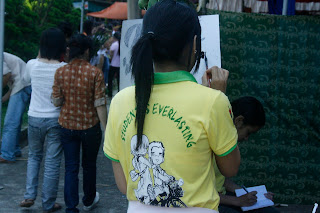
 Did it hit you, as it hit me, that the slogans on the shirts are, for the most part, printed in English? I asked the husband about this, and he said that he got the impression in his meeting with the vice rector of the university that all students at Hue University are required to study English. In the advanced program in physics, much of the first year of study is English instruction, so that when the professors come from the US to teach the physics classes, the students have some degree of English proficiency. It is probably similar here to what we heard from one of the husband’s Norwegian cousins when we last visited there 19 years ago. Norway is a small player on the world stage, so people there can’t expect people in other countries to learn Norwegian. If Norway wants to deal with other countries, they need a common, global language, and English is the closest thing to that at least for now. No, English is not the most widespread language in terms of native speakers, but as a second language, it may get you the farthest.
Students have been quite inventive in the decoration of their booths


 Yes, that is a giant AK-47. I couldn’t find out exactly what student group had put it up, but the booth had something to do with the anniversary of the liberation of Hue.
The students were also very creative in the design arena, crafting a full-sized stage out of hundreds of desks linked together. When we first arrived, just as the celebration was starting at 9:00, we checked on the physics students first. Their booth featured a dart game in which you tried to predict the sum of the three squares that your darts hit.
  And here’s the husband trying to explain what a University of Virginia “Cavalier” is to one of his Vietnamese students after being asked about the crossed swords in the UVa logo.
  Walking around the celebration, we were something of a novelty. It’s probably safe to say that most students were not expecting to see an American family enjoying the celebration. We were the first patrons of the psychology majors’ coffee shop,
  where we enjoyed coffee with sweet milk and one of the citrus fruits I’ve enjoyed here but never seen in the States.
  We got a very large round of applause when we departed. We got invited into most of the booths we passed, with some students being more creative than others in ensuring our attendance. Two young ladies just sort of grabbed the husband at one point.
  I don’t know what this group is majoring in, but they were selling pieces of bamboo stuffed with sticky rice. They got a big laugh when they realized that we didn’t know that the bamboo had to be whacked against a tree to “open” it so that the rice could be picked out.
 We also bought some dragonflies being sold by one of the physics groups. They illustrate to concepts of center of mass and center of gravity by balancing, in this case on one of younger son’s toes.
  Finally, the husband played another dart game,
  winning me two packages of these
Prawn Crackers, which are 3 percent shrimp and actually very tasty. It turns out that older son had tried these before in the States, though I’ve certainly never seen them there.
It all made for a very interesting day. The excitement and school spirit of these students was unlike anything I’ve ever seen from an American college student. I’ve read that in the States, the bachelor’s degree is becoming what a high school diploma used to be in terms of the basic job entry requirement. Although there are still some students in the States who are the first in their family to attend or graduate from college, college is not nearly the big deal that it is here. I don’t know the percentage of college-aged people who are actually in college here, or in the States for that matter, but I imagine that it’s much higher at home than it is here. That may explain some of it, but it probably doesn’t explain all of it. I thought for a while about whether the students here might have a non-worldliness or innocence that the students at home have lost, but I don’t really know if that explains it. Of course, the fact that we get HBO, CNN, ESPN, Discovery, and the National Geographic channel on the TV we have in our hotel room in no way implies that the students get them or watch them. I just know that it was incredibly refreshing to see the students’ excitement.
At the same time, it felt very strange to be so much the center of attention. The husband said that he wondered if that’s what celebrities felt like, with everyone competing for their attention. Older son pointed out that that was why celebrities had entourages and bodyguards, to put up a wall between them and the people who wanted their attention. While it certainly felt funny to have students actually applaud us (literally, as in many hands clapping) when we thanked them and moved on (this happened at several places, not just the psychology coffee shop), it also made me happy that our presence could cause that. I know that sounds incredibly juvenile and hokey to say, but it’s true. It was just kind of nice that our presence had that effect.
 Those in the regular (that is, not the advanced) program in physics are training to be physics teachers, and I absolutely loved their shirts.

 You may not be able to see it in this photo, but the atom on the front of the shirt has an apple as the nucleus—an apple for a teacher, even here in Vietnam. And there’s no mistaking the statement on the sleeve. There were some other interesting shirts as well.
 Did it hit you, as it hit me, that the slogans on the shirts are, for the most part, printed in English? I asked the husband about this, and he said that he got the impression in his meeting with the vice rector of the university that all students at Hue University are required to study English. In the advanced program in physics, much of the first year of study is English instruction, so that when the professors come from the US to teach the physics classes, the students have some degree of English proficiency. It is probably similar here to what we heard from one of the husband’s Norwegian cousins when we last visited there 19 years ago. Norway is a small player on the world stage, so people there can’t expect people in other countries to learn Norwegian. If Norway wants to deal with other countries, they need a common, global language, and English is the closest thing to that at least for now. No, English is not the most widespread language in terms of native speakers, but as a second language, it may get you the farthest.
Students have been quite inventive in the decoration of their booths


 Yes, that is a giant AK-47. I couldn’t find out exactly what student group had put it up, but the booth had something to do with the anniversary of the liberation of Hue.
The students were also very creative in the design arena, crafting a full-sized stage out of hundreds of desks linked together.
 When we first arrived, just as the celebration was starting at 9:00, we checked on the physics students first. Their booth featured a dart game in which you tried to predict the sum of the three squares that your darts hit.
  And here’s the husband trying to explain what a University of Virginia “Cavalier” is to one of his Vietnamese students after being asked about the crossed swords in the UVa logo.
  Walking around the celebration, we were something of a novelty. It’s probably safe to say that most students were not expecting to see an American family enjoying the celebration. We were the first patrons of the psychology majors’ coffee shop,
  where we enjoyed coffee with sweet milk and one of the citrus fruits I’ve enjoyed here but never seen in the States.
  We got a very large round of applause when we departed. We got invited into most of the booths we passed, with some students being more creative than others in ensuring our attendance. Two young ladies just sort of grabbed the husband at one point.
  I don’t know what this group is majoring in, but they were selling pieces of bamboo stuffed with sticky rice. They got a big laugh when they realized that we didn’t know that the bamboo had to be whacked against a tree to “open” it so that the rice could be picked out.
 We also bought some dragonflies being sold by one of the physics groups. They illustrate to concepts of center of mass and center of gravity by balancing, in this case on one of younger son’s toes.
  Finally, the husband played another dart game,
  winning me two packages of these
Prawn Crackers, which are 3 percent shrimp and actually very tasty. It turns out that older son had tried these before in the States, though I’ve certainly never seen them there.
It all made for a very interesting day. The excitement and school spirit of these students was unlike anything I’ve ever seen from an American college student. I’ve read that in the States, the bachelor’s degree is becoming what a high school diploma used to be in terms of the basic job entry requirement. Although there are still some students in the States who are the first in their family to attend or graduate from college, college is not nearly the big deal that it is here. I don’t know the percentage of college-aged people who are actually in college here, or in the States for that matter, but I imagine that it’s much higher at home than it is here. That may explain some of it, but it probably doesn’t explain all of it. I thought for a while about whether the students here might have a non-worldliness or innocence that the students at home have lost, but I don’t really know if that explains it. Of course, the fact that we get HBO, CNN, ESPN, Discovery, and the National Geographic channel on the TV we have in our hotel room in no way implies that the students get them or watch them. I just know that it was incredibly refreshing to see the students’ excitement.
At the same time, it felt very strange to be so much the center of attention. The husband said that he wondered if that’s what celebrities felt like, with everyone competing for their attention. Older son pointed out that that was why celebrities had entourages and bodyguards, to put up a wall between them and the people who wanted their attention. While it certainly felt funny to have students actually applaud us (literally, as in many hands clapping) when we thanked them and moved on (this happened at several places, not just the psychology coffee shop), it also made me happy that our presence could cause that. I know that sounds incredibly juvenile and hokey to say, but it’s true. It was just kind of nice that our presence had that effect.
Friday, March 27, 2009
A Tale of Two Pagodas
We’ve visited two pagodas so far in Hue, and the two are as different as night and day. In the old SAT verbal analogy game, the comparison would be something like Bao Quoc Pagoda is to Tu Dam Pagoda as Grace Episcopal Church in Keswick (or any other small, chapel-like church) is to Notre Dame or Cologne cathedral, though even that fails to capture the true difference. I’ll walk you through the two, and maybe after the photos, any explanation I can offer will make a bit more sense. If the lighting looks a bit different in some of the photos from Bao Quoc, it’s because they may have been taken on any one of the three visits I’ve made there, which sort of tells you which pagoda I prefer.
Both pagodas are in the same neighborhood, on side streets off the street Dien Bien Phu. Entry to Bao Quoc is up a long stairway into a bare courtyard.
  Here’s a close-up of the ornate scrollwork at the top of the building.
  If you can’t see the detail of the symbol at the top, here it is on something else in a shot I took in one of the courtyards to the side of the main building.
  Yes, it’s a swastika or variation thereof. You may have heard that Hitler had to get it from somewhere. Since 1940, Bao Quoc has been a school for training Buddhist monks, and it really does seem more like a school than a “church.” There is a room with a small altar,
  though the husband commented that the many-armed figure seemed more closely connected with Hinduism than with Buddhism. And though we saw several signs of human habitation, on the first visit we didn’t see anyone else there. On subsequent visits we saw monks (some were young monks—are they called “novices”?) walking around or sitting at a table talking. On the first visit, we only saw shoes in front of doorways,
 and a cat with one set of shoes
 We saw robes hanging to air or to dry.
 Apart from people, I saw some designs I want to remember in terms of my quilting.
 Off the main courtyard there are some smaller places with statues and pools of water.

 There’s also what appears to be a tomb area.
  There are lots of trees
 and many, many peaceful places to sit. I felt a peace or serenity at Bao Quoc that I don’t often feel, and it was very, very nice.
Tu Dam pagoda is further up Dien Bien Phu from Bao Quoc, and you notice right upon entering the grounds that it’s a different sort of pagoda. From this view of this large tower, which is under some sort of renovation, there is a gift shop at your back. Because I actually have what I call my “Vatican church-key,” a bottle-opener key ring I purchased from a nun at a gift shop on the roof of St. Peter’s in Rome, I am hardly one to pass judgment on a gift shop at a house of worship. I’ll just note that it was there (and that I have on my wrist as I type a bracelet that I purchased there at the end of our visit).
Here are the steps up into what looks to be the main worship area. We entered through the side, accompanied by a woman who accosted us in the courtyard where the first tower was and led us to believe she was some sort of guide. She had us remove our shoes and then led us through a side door into the huge main room. She offered us incense to light and add to a small altar.
  The fact that she then asked for $1 US from each of us and put this in her pocket rather than in some collection jar let us know that she was your basic local huckster rather than some sort of official pagoda guide. Along one wall of the room were several very ornate altars.

 On the side of the room opposite the altars there was a bell in an alcove to one side and a drum in an alcove to the other, an arrangement we have seen elsewhere including on the roof galleries of the Ngo Mon Gate into the Imperial City.
 There are some pleasant areas outside the huge main building,
 and they are expanding the buildings on the pagoda grounds.
  According to the guidebook, Tu Dam Pagoda’s chief importance is as a center for supporting Buddhism. Maybe the glitz helps in that regard, but it certainly didn’t have the spiritual feel for me that Bao Quoc Pagoda did. If I had to choose between the two in terms of a spiritual “home” or place just to sit and ponder, Bao Quoc would win hands down.
This weekend (March 28-29) is a big celebration at Hue University. Hue was liberated from the Americans on March 26, 1975. In addition, this week marks the anniversary of the founding of some sort of student union, perhaps even the Communist Party one. Classes are cancelled on Saturday, meaning the husband gets a three-day weekend. We may attend some of the celebration festivities on Saturday, though we may also go across the river to a shoe-maker since the sons are interested in getting tailored suits if they can also get some tailored shows or sandals to go with the suits. Sunday we may bicycle to some tombs south of the city with a shopkeeper we have become friends with.
We have just a bit more than a week left here in Hue, and it will be hard to leave. Our life here has a very nice routine. While it would get old eventually (hotels are like that), it has only just started to feel a bit “old.” Hue is a very nice small city. Although there are times I would like to have a t-shirt emblazoned with “No, I do not wish to purchase your goods or services” in Vietnamese, I do like it here a lot. It has been a luxury to have had a month in which to get the feel of Hue, to see things somewhat at leisure. We will not have this luxury in the rest of our trip, but I think the relaxed pace we have had here has left us rested and ready for the next, faster parts of the trip.
Both pagodas are in the same neighborhood, on side streets off the street Dien Bien Phu. Entry to Bao Quoc is up a long stairway
 into a bare courtyard.
  Here’s a close-up of the ornate scrollwork at the top of the building.
  If you can’t see the detail of the symbol at the top, here it is on something else in a shot I took in one of the courtyards to the side of the main building.
  Yes, it’s a swastika or variation thereof. You may have heard that Hitler had to get it from somewhere. Since 1940, Bao Quoc has been a school for training Buddhist monks, and it really does seem more like a school than a “church.” There is a room with a small altar,
  though the husband commented that the many-armed figure seemed more closely connected with Hinduism than with Buddhism. And though we saw several signs of human habitation, on the first visit we didn’t see anyone else there. On subsequent visits we saw monks (some were young monks—are they called “novices”?) walking around or sitting at a table talking. On the first visit, we only saw shoes in front of doorways,
 and a cat with one set of shoes
 We saw robes hanging to air or to dry.
 Apart from people, I saw some designs I want to remember in terms of my quilting.
 Off the main courtyard there are some smaller places with statues and pools of water.

 There’s also what appears to be a tomb area.
  There are lots of trees
 and many, many peaceful places to sit. I felt a peace or serenity at Bao Quoc that I don’t often feel, and it was very, very nice.
Tu Dam pagoda is further up Dien Bien Phu from Bao Quoc, and you notice right upon entering the grounds that it’s a different sort of pagoda.
 From this view of this large tower, which is under some sort of renovation, there is a gift shop at your back. Because I actually have what I call my “Vatican church-key,” a bottle-opener key ring I purchased from a nun at a gift shop on the roof of St. Peter’s in Rome, I am hardly one to pass judgment on a gift shop at a house of worship. I’ll just note that it was there (and that I have on my wrist as I type a bracelet that I purchased there at the end of our visit).
Here are the steps up into what looks to be the main worship area.
 We entered through the side, accompanied by a woman who accosted us in the courtyard where the first tower was and led us to believe she was some sort of guide. She had us remove our shoes and then led us through a side door into the huge main room. She offered us incense to light and add to a small altar.
  The fact that she then asked for $1 US from each of us and put this in her pocket rather than in some collection jar let us know that she was your basic local huckster rather than some sort of official pagoda guide. Along one wall of the room were several very ornate altars.

 On the side of the room opposite the altars there was a bell in an alcove to one side and a drum in an alcove to the other, an arrangement we have seen elsewhere including on the roof galleries of the Ngo Mon Gate into the Imperial City.
 There are some pleasant areas outside the huge main building,
 and they are expanding the buildings on the pagoda grounds.
  According to the guidebook, Tu Dam Pagoda’s chief importance is as a center for supporting Buddhism. Maybe the glitz helps in that regard, but it certainly didn’t have the spiritual feel for me that Bao Quoc Pagoda did. If I had to choose between the two in terms of a spiritual “home” or place just to sit and ponder, Bao Quoc would win hands down.
 This weekend (March 28-29) is a big celebration at Hue University. Hue was liberated from the Americans on March 26, 1975. In addition, this week marks the anniversary of the founding of some sort of student union, perhaps even the Communist Party one. Classes are cancelled on Saturday, meaning the husband gets a three-day weekend. We may attend some of the celebration festivities on Saturday, though we may also go across the river to a shoe-maker since the sons are interested in getting tailored suits if they can also get some tailored shows or sandals to go with the suits. Sunday we may bicycle to some tombs south of the city with a shopkeeper we have become friends with.
We have just a bit more than a week left here in Hue, and it will be hard to leave. Our life here has a very nice routine. While it would get old eventually (hotels are like that), it has only just started to feel a bit “old.” Hue is a very nice small city. Although there are times I would like to have a t-shirt emblazoned with “No, I do not wish to purchase your goods or services” in Vietnamese, I do like it here a lot. It has been a luxury to have had a month in which to get the feel of Hue, to see things somewhat at leisure. We will not have this luxury in the rest of our trip, but I think the relaxed pace we have had here has left us rested and ready for the next, faster parts of the trip.
Subscribe to:
Comments (Atom)